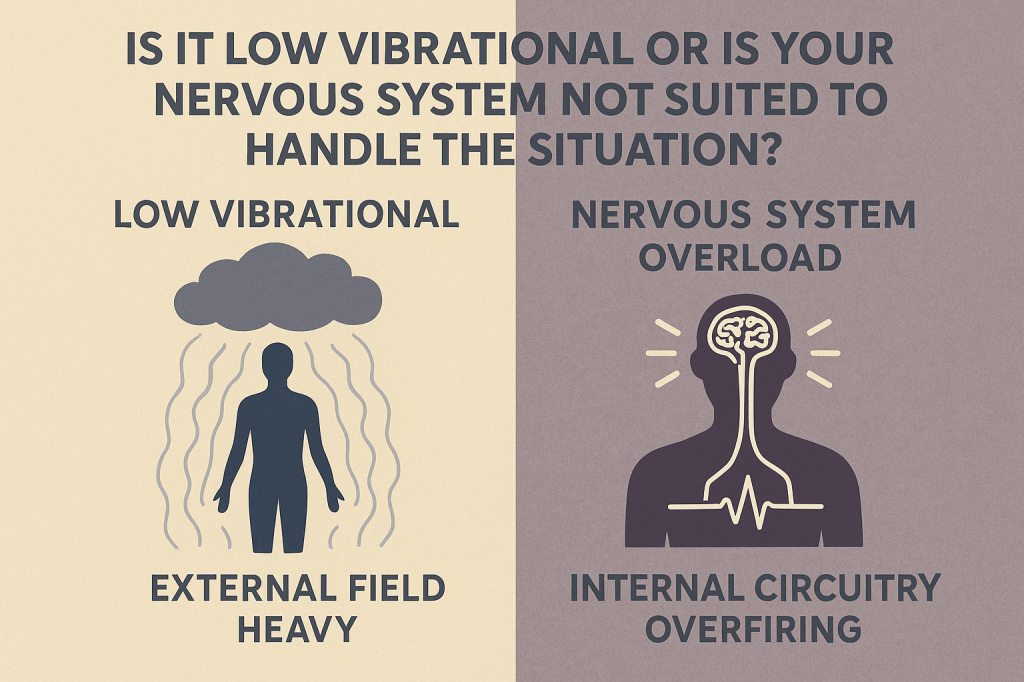
• Human experience is layered. At times, we find ourselves in environments or around people who feel “off.” We might label them as low vibrational—toxic, draining, or energetically heavy.

    Other times, what we are actually feeling is our own nervous system’s limits being reached, not necessarily the vibration of the external environment. Distinguishing the two is key to spiritual growth, inner peace, and embodied awareness.

    The Metaphysical Lens: Vibrations and Energy Fields.

    In metaphysics, everything is vibration. Emotions, thoughts, and even environments carry a frequency. Fear, shame, jealousy, or manipulation resonate at slower, denser frequencies, which we call low vibration. Love, peace, creativity, and truth vibrate at faster, lighter frequencies, known as high vibration.


    When you step into a room, your energetic body—your aura—interacts with the energy field around you. If that field is heavy, you feel your light dimming. This is an intuitive signal: the space itself may be “low vibrational,” urging you to guard your energy.
    But sometimes, the field is not heavy at all. The vibration might even be high, expansive, and loving—yet your system feels overwhelmed. That’s where science bridges the metaphysical.

    The Nervous System Science: Capacity and Regulation.

    Your nervous system is the biological interface between soul and body. It determines how much energy, sensation, and information you can process in a moment.


    Regulated Nervous System: You feel present, safe, and able to connect. Even intense experiences can be processed.
    Dysregulated Nervous System: You may enter fight (anxiety, anger), flight (avoidance, overwhelm), or freeze (shutdown, numbness).


    A high-vibrational situation (like deep intimacy, profound silence, or a powerful spiritual event) can still trigger discomfort if your nervous system isn’t ready to hold that level of intensity. What you experience is not “low vibration”—it’s simply your system signalling its current limit.

    The Spiritual Bridge: Soul Growth Through Capacity.


    From a spiritual view, this distinction is crucial:
    Low Vibrational Situations test your discernment. They invite you to withdraw your energy, protect your field, and not be entangled in draining patterns.
    Nervous System Overload tests your embodiment.

    They invite you to strengthen your connection to the vessel—the “VR suit” of your body—so your soul can anchor more light and meet greater levels of experience without collapsing.


    This is why many mystics and healers emphasize nervous system healing. If your system is expanded and regulated, you can sit in situations that once overwhelmed you and remain grounded, discerning, and luminous.


    How to Tell the Difference
    Ask energetically: “Does this feel heavy and contracting?” → likely low vibration.
    Ask somatically: “Is my body racing, shutting down, or overstimulated even though nothing negative is happening?” → likely nervous system dysregulation.


    Practice Text (for real-life use)


    When you feel overwhelmed, silently repeat:
    “I call my energy back to myself. If this space is not aligned with my vibration, I release it with love. If this is my nervous system feeling stretched, I breathe into my body and remind it: it is safe to hold more.”


    This short affirmation lets you check both possibilities—shielding your field while calming your nervous system.


    In truth, both layers are sacred teachers. The world shows you what energies are misaligned, while your body shows you how much light you are currently able to hold. Spiritual maturity comes not just from avoiding low vibrations but from building a nervous system strong enough to carry higher ones.

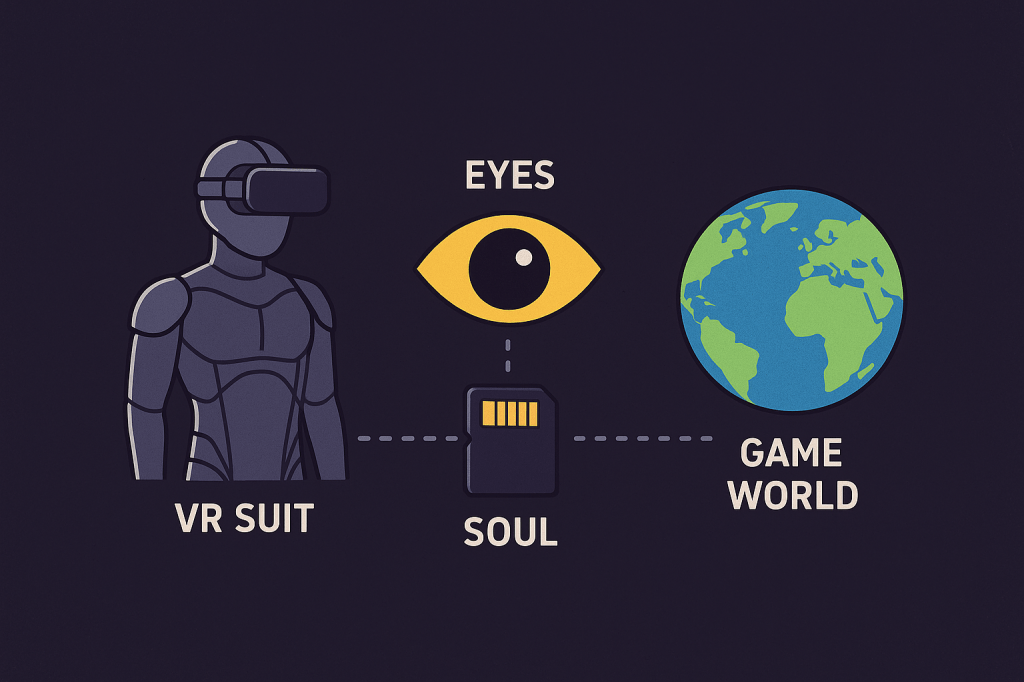
  • From a spiritual and metaphysical perspective, human life can be understood as a multidimensional simulation. Consciousness, infinite and formless, enters this reality through a carefully designed system: the body as a VR suit, the eyes as goggles, and the soul as the memory card carrying all progress from past lives.

    This model reveals not only how we interact with the world but also why we are here.


    The Body as a Suit for Exploration of stimuli.


    The human body is not your true self but the vessel you inhabit. It functions like a VR suit, equipped with sensory systems — touch, taste, sight, smell, hearing — that allow your awareness to experience this dense environment.
    It is also a space suit, protecting you in a realm where pure consciousness could not exist directly. The suit regulates breath, temperature, and energy, filtering sensations so that you can remain anchored in this world. Far from being a prison, the body is a tool for exploration, growth, and mastery.


    The Eyes as the Soul’s Goggles.


    Your eyes act as lenses for your consciousness, much like the goggles of a VR headset. They take in vibrations of light and transmit them as images to your mind.
    Yet the eyes are more than receivers — they are portals. Alongside them, the pineal gland (often called the “third eye”) serves as an inner screen. Here, visions, dreams, and spiritual insights appear.

    Together, the physical eyes and the third eye form a multidimensional interface, allowing you to perceive both the outer simulation and inner realities.


    The Soul as the Memory Card.


    If the body is the suit and the eyes the goggles, then the soul is the memory card. It records everything you experience across lifetimes. Every lesson, wound, gift, and breakthrough is stored as energetic data.
    Talents and instincts in this life may be carryovers from previous incarnations. 

    Repeated challenges are unresolved patterns returning for completion.
    Deep connections with others often come from past-life bonds.
    When one body is laid down, the memory card is not lost. The soul carries its data forward, downloading into a new avatar to continue the journey. In this way, no experience is wasted , everything becomes part of the soul’s eternal archive.


    The Quantum Perspective.


    Modern physics aligns with this vision. Reality does not exist as a fixed structure but as probabilities that collapse into form when observed. Consciousness — the true player — shapes the experience by engaging with the field.
    What we call time is not linear. The soul’s memory card contains not only what has been lived but also the blueprint of future possibilities. Glimpses of this arise in déjà vu, dreams, or sudden flashes of knowing, when the boundaries of the current simulation momentarily open.

    Living as a Conscious Player.


    Seeing life in this way shifts everything. You are not the suit but the one wearing it. You are not trapped in a single lifetime but progressing through many.

    You are not separated from others but sharing the same source consciousness playing different roles.
    When you remember this, you begin to live as a conscious player rather than a passive avatar. You care for your suit, refine your perception, and honour your soul’s memory card by integrating its lessons. Life becomes less about survival and more about awakening.

    Conclusion.


    The body is the VR and space suit, the eyes are the goggles, and the soul is the memory card holding the story of countless lives. Together, they allow consciousness to immerse itself in Earth’s vast simulation. Each incarnation is another level of play, another chance to grow, heal, and unlock higher awareness.
    When you understand this, you no longer see life as random. You see it as a sacred game of remembrance — where the ultimate goal is not just to play, but to remember the eternal player behind the suit.

  • Whatever you use to run away from your earthly problems because it triggers you is a form of escapism.it does not matter what kind of thing you use, positive or negative as long as your goal is to escape then it is escapism.

    Spirituality is meant to liberate, to bring us into deeper alignment with truth, peace, and love. Yet, for many seekers, spirituality can subtly become another form of escape. Instead of facing reality head-on, people hide behind rituals, affirmations, or spiritual language—hoping these practices will shield them from discomfort. True spirituality, however, is not about bypassing life. It is about entering life fully.


    The Trap of Spiritual Bypassing.


    “Spiritual bypassing” is when people use spiritual ideas to avoid unresolved emotions, wounds, or responsibilities. For example, instead of dealing with anger, they insist “everything is love.” Instead of addressing real problems, they say “the universe will handle it.” While these statements hold a seed of truth, they can become a way of avoiding growth.
    This is escapism disguised as enlightenment.


    Real Growth Requires Shadow Work


    Authentic spirituality demands honesty. It means confronting your fears, triggers, and limitations—not hiding them under positive affirmations. The shadow self—the parts of you you’d rather ignore—is not an obstacle to enlightenment; it is the doorway to it. By integrating your shadow, you embody wisdom rather than simply speaking it.


    Presence, Not Escape.


    True spiritual practice does not take you away from life but deeper into it. Meditation is not a retreat from problems, but a way of meeting them with clarity. Prayer is not asking for escape, but aligning with strength to face what is. Awareness is not an avoidance tool; it is a lens that reveals truth.


    Living Spirituality in the Real World.


    A mature spiritual path is not about floating above life but walking fully in it. It shows in how you treat others, how you respond to challenges, how you show up in relationships, work, and service. The divine is not separate from the ordinary—the divine is woven into it.


    Conclusion.


    Spirituality is not a hiding place; it is a pathway of transformation. When used as escapism, it weakens. When embraced as truth, it strengthens. To stop using spirituality as an escape is to step into your full power—where the sacred and the human meet in one authentic life.

  • For many of us, the idea of God was given long before we had the chance to question it. Parents, teachers, religious institutions, and even cultural traditions handed us a definition of God—and we accepted it because we had no other choice. But what happens when that definition no longer feels true, or when it creates more fear than freedom? That’s where redefining God becomes a deeply personal and liberating journey.


    Inherited Definitions vs. Personal Experience.


    Most people relate to God through second-hand knowledge: sermons, scriptures, doctrines, or family teachings. While these sources carry wisdom, they can also project human fears, judgments, and limitations onto something infinite. The danger is mistaking other people’s interpretation of God for your own direct connection.
    When God is defined only through fear, punishment, or guilt, our spiritual life can feel heavy and suffocating. But when God is defined through love, presence, and awareness, something shifts—our relationship with ourselves, with others, and with life itself begins to feel lighter.


    The Power of Redefinition.


    Redefining God does not mean rejecting faith; it means moving closer to truth. It means asking: Who is God to me? What do I feel when I strip away projections?

    The answers are not found in dogma but in direct experience—silence, meditation, reflection, and the subtle whispers of the soul.
    God may no longer appear as a distant ruler in the sky, but as the energy that breathes through you, the intelligence woven into nature, or the consciousness that observes your thoughts. God becomes less about rules and more about relationship.

    Why It Matters.


    Your definition of God shapes how you live. If you see God as punishing, you may live in constant fear. If you see God as distant, you may feel abandoned. But if you see God as love, awareness, or infinite intelligence, then life becomes a sacred unfolding, not a prison.
    By redefining God, you reclaim your spiritual freedom. You no longer rely solely on borrowed beliefs; instead, you live from a space of alignment and authenticity.


    Conclusion.
    The question “Who is God to you?” is not meant to be answered once and for all. It is a living question, an evolving dialogue between your soul and the infinite. Redefinition is not rebellion—it is remembrance. You are not discarding God; you are peeling back the layers of projection to meet God as truth.
    In the end, redefining God is not about creating a new image—it’s about realizing that the divine cannot be contained by any image at all.


  • At first, the phrase sounds harsh, as though it is calling human intelligence limited or small. Yet its meaning is far more profound. It suggests that no matter how clever we become with logic, strategy, or resistance, there is a deeper intelligence guiding our lives — the intelligence of the soul.


    The Soul’s Blueprint.


    Spiritual traditions often describe life as a pre-written script or blueprint designed by the soul before incarnation. In this view, each person chooses certain themes: lessons in love, patience, resilience, power, humility, or service. These themes act like threads woven into the tapestry of our experiences.
    The human mind, however brilliant, operates within time. It sees fragments, struggles with uncertainty, and often confuses comfort with purpose. The soul, by contrast, is timeless. It sees lifetimes at once, understands karma as cause and effect across dimensions, and knows what experiences will ultimately expand consciousness. Thus, while the personality thinks it can “outsmart fate,” the very field in which it thinks is contained within the soul’s larger plan.


    The Illusion of Control.


    We make choices daily — where to live, who to love, what to pursue — and these choices feel like free will. But in the deeper picture, free will is exercised within boundaries set by the soul. You can take detours, delay growth, or resist certain lessons, but the essential encounters and teachings will arrive regardless.
    It is like being inside an open-world video game. You may choose your route, fight or avoid certain battles, or explore side quests. Yet the core storyline is coded into the game itself. You cannot uninstall the main quest from inside the game, because the very code you would need to alter was written by you — the higher self — before the game began.


    Why the Mind Cannot Outwit the Soul.


    The ego-mind thrives on cleverness: strategies, plans, avoidance, denial. But cleverness operates only at the surface. The soul works through synchronicity, intuition, accidents, delays, dreams, and magnetic pulls toward people and places. Even when the mind resists, the soul redirects events until the lesson is met.
    This is why cycles repeat. The same type of relationship, challenge, or opportunity appears again and again, sometimes in different disguises. It is not life punishing you — it is the soul ensuring its blueprint is fulfilled. The mind is not “dumb” but it is limited, like a chess piece believing it knows the entire game while the soul is the grandmaster moving all the pieces across lifetimes.


    The Paradox of Freedom.
    Humans do have free will, but it exists within the architecture of destiny. You can not remove the main lesson, but you can decide how you will walk through it: with resistance or with grace, with fear or with trust. Freedom lies in your response, not in the erasure of the blueprint.
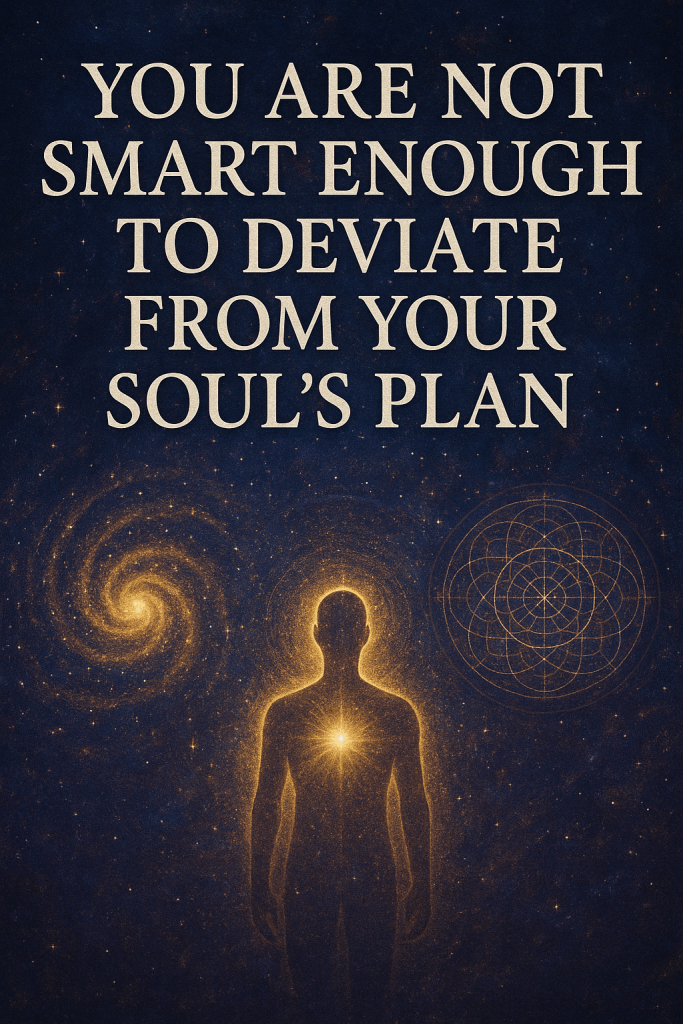
    Thus, “you are not smart enough to deviate from your soul’s plan” is not an insult — it is liberation. It means you can stop exhausting yourself trying to outwit destiny. Instead, you can lean into alignment, listening to the whispers of intuition and following the magnetic pull of synchronicity.


    Living With the Soul’s Intelligence.


    Recognizing the soul’s plan does not require knowing every detail of destiny. It begins with noticing recurring patterns, honouring inner callings, and trusting that even apparent mistakes serve a higher purpose. When you realize that you can not derail your deepest path, a great burden lifts. Life stops being a puzzle to solve and becomes an unfolding mystery to participate in.

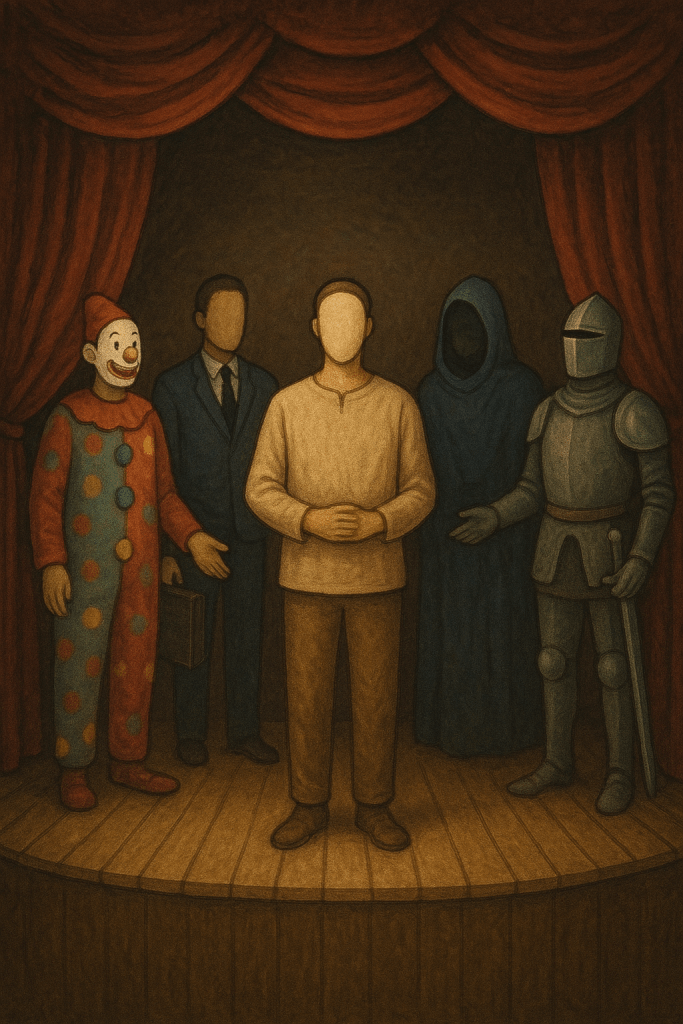
  • What if life is a theatre, and the people we meet are like actors cast into roles? On the surface, they appear as separate individuals,  a friend, a stranger, a teacher, a lover, or even an enemy. But what if the twist is that it’s all one consciousness, one actor, slipping into different costumes to play every part?


    This perspective has deep roots in spiritual and mystical traditions. Many teachings suggest that there is only one awareness, infinite and indivisible, wearing the masks of countless beings. Just as an actor loses themselves in a role, this consciousness forgets its true identity each time it steps into a new character so the play can feel real.
    From this view, you and I are not separate at all.

    We are the same actor experiencing itself through different storylines. Every encounter is the One Self meeting itself — like your left hand reaching for your right hand.


    The amnesia is essential. If we remember, at all times, that everyone is just another version of ourselves, the drama of life would collapse. Forgetting makes the story believable, just as a movie only grips us when we suspend disbelief. Consciousness commits so fully to each role that the illusion of separation feels absolute.


    Even in the language of science, there are faint echoes of this idea. Quantum entanglement suggests that what appears separate is still mysteriously connected. Holography shows that every fragment of an image still contains the whole.

    These don’t prove the oneness of consciousness, but they rhyme with the idea that individuality is local, while the foundation of reality is unified.


    To live with this understanding changes everything. Every person becomes a mirror, another angle of yourself looking back. Judgments soften, compassion arises naturally, and conflict loses its sharp edge. To harm another would be like wounding your own hand. To love another is to return home to yourself.


    And still, the play continues. The beauty of the stage is not cancelled by the recognition of the actor behind it. If anything, it deepens the mystery — watching the One weave itself into countless roles, dancing between forgetting and remembering, creating a story so vivid we take it for real.

  • When you form an intent, you’re not just thinking of a possibility—you’re actually aligning yourself with a version of reality where that possibility already exists. In quantum physics, reality doesn’t move in a straight line from past to future.

    Instead, all possibilities exist at once, like waves of probability. Your intent is what collapses one of those waves into a definite path.
    If time is not strictly one-directional, then the future can also influence the present. This is called retrocausality in quantum theory: outcomes in the future can ripple back and shape the conditions of the past. From that view, the reason you feel the intent arises inside you is because your future self has already secured that reality, and the signal of that fulfilment is echoing backwards into your present moment.


    On the spiritual side, intent is a command to the universe. The moment you truly decide, you shift your vibration to match the version of you that already has what you want. Doubt only belongs to the linear mind that thinks in terms of “not yet.” But if time folds on itself, then “not yet” is an illusion. The thing is already yours, and intent is your proof. The desire was planted in you because the fulfilment already exists.


    So when you intend, you’re not waiting for something to happen. You’re tuning into what has already happened in another layer of time and allowing it to become visible in this one.

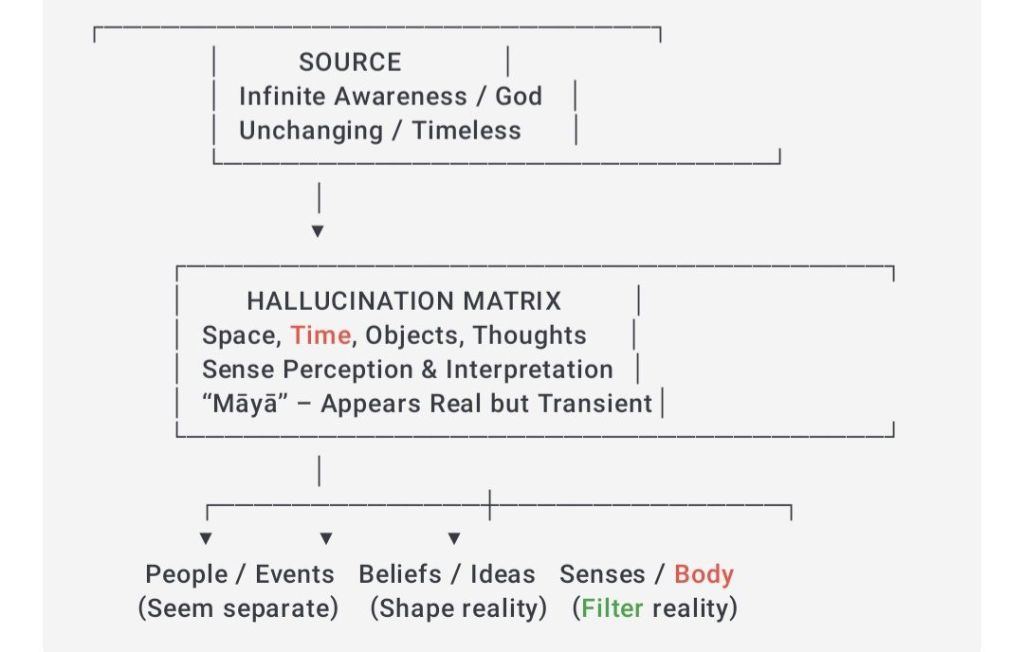
  • What we call source or God is also known as the unconditioned reality, “Source” means the fundamental reality that gives rise to everything , it is pure awareness, God, the Absolute, the Tao, Brahman, or whatever name you choose. 

    It’s described as unchanging, infinite, and nondual beyond time, space, or form.


    In this model, Source isn’t something inside the universe; it’s the ground from which the whole universe arises.

    The Hallucination Matrix.

    Hallucination matrxi in this context can also be known as the Conditioned Reality. Everything “outside” Source,  meaning everything that appears as separate: objects, people, ideas, planets, galaxies  is part of what mystics call Māyā (illusion), or in modern language, a “matrix” or simulation.


    It’s “hallucinatory” not because it’s meaningless but because it doesn’t have independent reality.
    Just like a dream feels real when you’re inside it but dissolves when you wake up, the matrix feels real until you realize it’s being projected by consciousness itself.


    It is known as a hallucination because Perception is filtered: your senses, beliefs, culture, nervous system all shape what you experience.

    You don’t see “reality”. You see your interpretation of reality.
    Quantum physics even supports this metaphor matter isn’t solid objects but probabilities observed by consciousness.
    Because all phenomena are transient and dependent on perception, from the “Source” point of view, they are “dreamlike” or “hallucinatory.”


    The Matrix Aspect.


    A “matrix” here is not literally a computer simulation (though some use that metaphor) but a network of patterns — space, time, cause, effect, identity.
    It’s a self-reinforcing system: perceptions create beliefs and beliefs reinforce perceptions.

    Inside it, everything seems separate, but in truth, all of it is one movement of Source.


    If only Source is real, then what you experience day-to-day is a training ground, a dream, a mirror.
    You don’t have to reject it.

    The point is to see through it.
    When you stop clinging to the dream as “absolutely real,” you stop suffering and start living from Source (awareness itself).

    Think of an ocean (source) producing waves (the matrix).
    The waves look separate, but they’re made of nothing but the ocean.
    If a wave forgets it’s ocean, it experiences fear, competition, and limitation.
    When it remembers it’s water, it sees all other waves as itself.
    The matrix is not “bad” or “evil.” It’s just illusory,  like a movie.
    Source is not “somewhere else.” It’s the very awareness you’re using to read these words.
    Seeing this directly is what traditions call enlightenment, awakening, gnosis, etc.

  • We often hear the phrase, “Your body belongs to you,” At first glance, it seems empowering  a call to self-ownership, autonomy, and self-respect.

    But when you look deeper, a more profound truth emerges: your body does not belong to you alone. It is a living vessel, a shared inheritance that carries the echoes of your ancestors and the infinite fractals of your existence across time and possibility.

    I prefer to make arguments from a scientific standpoint because too much imagination would make it seem like you’re talking about a sci-fi movie and not reality.

    For centuries, scientists have sought to understand the fundamental code of life. Today, it is a well-established scientific fact that the human body and indeed all living organisms are built from DNA. Deoxyribonucleic acid, or DNA, is not merely a component of life; it is the blueprint that directs the formation, function, and repair of every part of the body.

    Within nearly every cell of the human body lies DNA, tightly packed into chromosomes. This molecule contains instructions written in a four-letter chemical code—adenine (A), thymine (T), cytosine (C), and guanine (G). The sequence of these bases determines the order of amino acids in proteins, which are the essential building blocks of tissues, enzymes, and hormones.


    Without DNA, the body would have no instructions for how to form muscles, grow bones, or regulate vital processes. In short, DNA acts as the master architect of human biology.

    The proof is not only in laboratories, it is observable in daily life. A single mutation in DNA can change body structure or function, such as in sickle cell anaemia. Cloning experiments, such as Dolly the sheep, showed that an entire organism can be built from the DNA of just one cell.

    In forensic science, DNA is used to identify individuals with unmatched accuracy.

    And as we know it, DNA is more than just a molecule—it is a biological archive that stores and transmits information from one generation to the next.

    While philosophers and mystics have long spoken of “ancestral memory,” modern genetics provides evidence that our DNA is a living record of the past, shaping who we are before we are even born.

    Now that all the sciencing is done, we can all move to metaphysics, which i love, and say that since we all agree, energy doesn’t die and that all energy has essence and so that means those energy forms are literal beigns that are alive and have their own personalities and needs, etc.

    And some of us have the ability to percieve the subtle realms so we are able to percieve our body beign used to satisfy these needs, it might be as little as a craving of a drink or flavor, to the craving of someone that you otherwise would not be interested in.

    Some of us have the ability to perceive the emotions of the versions of us that lie in our Dna, and that is why we are depressed for no reason.

    Hopefully, this article is able to provide reprive to those who feel a certain weight for decisions they made that seemed spontaneous, or they carry a weight they didn’t create, or they basically just seem like its not their fault they are sad.

    Also, your body belongs to your higher self, but that’s another article. 😃

    #spirituality #Dna #Ancestralmemory

  • The word subliminal means “below the threshold of conscious perception.” Subliminal messages are sounds, words, or images designed to be detected by your senses but not strong enough to enter full conscious awareness. Common forms include:

    Audio subliminals: Affirmations layered under music, nature sounds, or white noise.

    Visual subliminals: Words or images flashed quickly in videos.

    Even when you don’t “hear” or “see” them clearly, your brain still picks them up.


    How the Brain Processes Subliminals

    1. Continuous Listening.
    Your brain is always scanning the environment. Even if you aren’t paying attention, the auditory system detects and processes sounds in the background.

    2. Subconscious Filtering.
    Most incoming information is filtered out before it reaches conscious awareness. However, the subconscious retains impressions and patterns — a phenomenon psychologists call implicit memory.

    3. Priming Effect.
    Subliminal affirmations often use positive statements like “I am calm” or “I am confident.” When repeated, these messages “prime” the brain, making related thoughts and feelings more accessible.

    4. Emotional Influence
    Background music, frequencies, or ambient sounds stimulate the limbic system  the emotional centre of the brain. This amplifies the mood-shifting effect of the hidden affirmations.


    Why Subliminals Influence Mood?

    1. Anxiety Relief: Soothing subliminals can reassure the subconscious, lowering stress responses without the listener actively “trying” to relax.

    2. Confidence Boost: Subtle affirmations help shift self-image over time, making confidence feel more natural.

    3: Focus & Motivation: Tracks with energetic undertones and productivity affirmations can encourage alertness and drive.


    Unlike conscious affirmations, which require active repetition, subliminals bypass resistance and work in the background.

    The brain and sensory input.

    Sensory input is continuous. Your ears (and other senses) are always picking up signals from the environment. Even if you’re focused on something else, your auditory system keeps processing sounds.

    Filtering happens automatically. Most of what you hear is processed at a low (subconscious) level by parts of the brain , ike the thalamus and brainstem. Only a small portion makes it to conscious awareness in your cortex.

    Selective attention. Your brain prioritizes certain information (like your name or a sudden loud sound) and “brings it up” to awareness when it thinks it’s important. This is why you can notice your name in a noisy room (“cocktail party effect”) even if you weren’t actively listening.

    Memory traces. Some of what you don’t consciously notice still leaves subtle memory traces or influences your mood and decisions — that’s why subliminal cues can sometimes affect behaviour.

    So your brain doesn’t store everything in perfect detail, but it’s always scanning and evaluating the environment, even when you’re not aware of it.