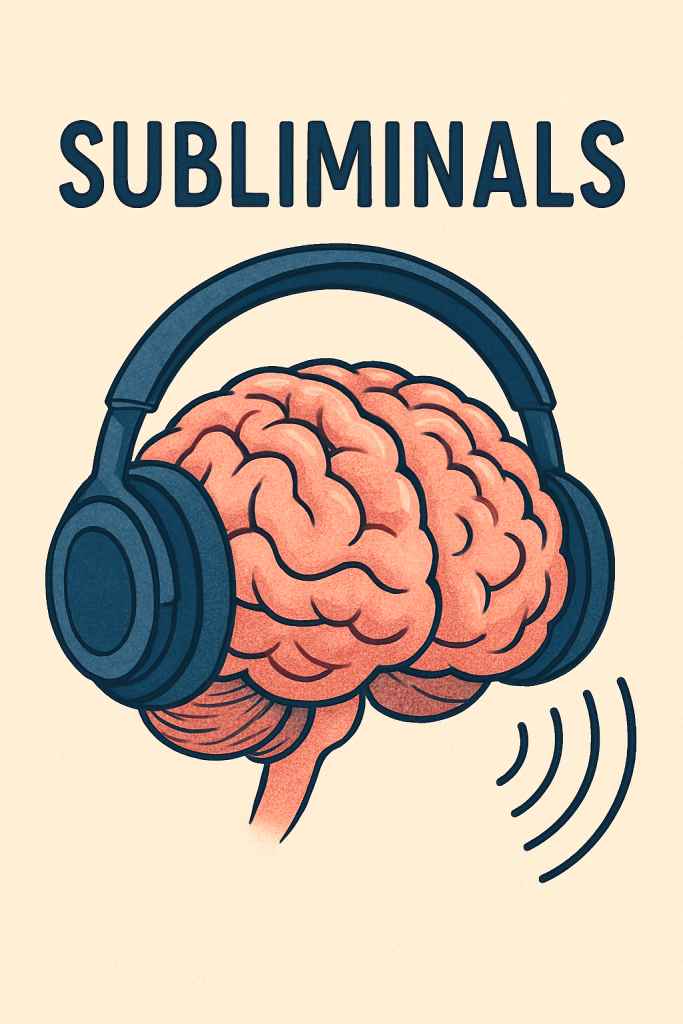
The word subliminal means “below the threshold of conscious perception.” Subliminal messages are sounds, words, or images designed to be detected by your senses but not strong enough to enter full conscious awareness. Common forms include:
Audio subliminals: Affirmations layered under music, nature sounds, or white noise.
Visual subliminals: Words or images flashed quickly in videos.
Even when you don’t “hear” or “see” them clearly, your brain still picks them up.
How the Brain Processes Subliminals
1. Continuous Listening.
Your brain is always scanning the environment. Even if you aren’t paying attention, the auditory system detects and processes sounds in the background.
2. Subconscious Filtering.
Most incoming information is filtered out before it reaches conscious awareness. However, the subconscious retains impressions and patterns — a phenomenon psychologists call implicit memory.
3. Priming Effect.
Subliminal affirmations often use positive statements like “I am calm” or “I am confident.” When repeated, these messages “prime” the brain, making related thoughts and feelings more accessible.
4. Emotional Influence
Background music, frequencies, or ambient sounds stimulate the limbic system the emotional centre of the brain. This amplifies the mood-shifting effect of the hidden affirmations.
Why Subliminals Influence Mood?
1. Anxiety Relief: Soothing subliminals can reassure the subconscious, lowering stress responses without the listener actively “trying” to relax.
2. Confidence Boost: Subtle affirmations help shift self-image over time, making confidence feel more natural.
3: Focus & Motivation: Tracks with energetic undertones and productivity affirmations can encourage alertness and drive.
Unlike conscious affirmations, which require active repetition, subliminals bypass resistance and work in the background.
The brain and sensory input.
Sensory input is continuous. Your ears (and other senses) are always picking up signals from the environment. Even if you’re focused on something else, your auditory system keeps processing sounds.
Filtering happens automatically. Most of what you hear is processed at a low (subconscious) level by parts of the brain , ike the thalamus and brainstem. Only a small portion makes it to conscious awareness in your cortex.
Selective attention. Your brain prioritizes certain information (like your name or a sudden loud sound) and “brings it up” to awareness when it thinks it’s important. This is why you can notice your name in a noisy room (“cocktail party effect”) even if you weren’t actively listening.
Memory traces. Some of what you don’t consciously notice still leaves subtle memory traces or influences your mood and decisions — that’s why subliminal cues can sometimes affect behaviour.
So your brain doesn’t store everything in perfect detail, but it’s always scanning and evaluating the environment, even when you’re not aware of it.
 Divine SUN
Leave a comment